Rethinking numbers

It’s not surprising that many people don’t exactly feel passionate about financial tasks like bookkeeping or detailed economic calculations. Most people avoid them when they can, and politely refer requests to colleagues in the finance department. After all, that’s where the people sit who have proven they aren’t intimidated by complex Excel formulas and forecasting systems. They deliver the numbers everyone else paints by. So everyone does what they do best. Makes sense, right?
The problem with numbers is that they suggest objectivity—but they are only a constructed reality. In organizations, we often use them to plan what is allowed and what is not. For example, when creating budgets. We make (more or less) defensible assumptions about the future and then orient our decisions around those plans for months at a time. The result is a fairly rigid framework that isn’t prepared for the constant dynamism of the environment. You could say: we try to construct the future through forecasts and calculations, and we often bend reality to fit when we realize the path we planned doesn’t match.
In an omnipresent, complex, and inherently unpredictable world—complete with multiple crises—carefully crafted budget fantasies are quickly disrupted. Hard-won future plans become obsolete the moment it becomes clear that an organization is not isolated from its environment, and that many things simply arrive unplanned, while new opportunities open up just as unexpectedly.
It becomes even more draining for purpose-driven organizations. They aim to align their decisions not only with economic survival but also with their own purpose. And that purpose looks outward—toward creating value for the common good. But what do you do when that purpose doesn’t “add up” through the lens of our traditional accounting frameworks? Then one of two things has to change: either the purpose or the lens.
To make this shift, we need a new understanding of organizations and their place in the world. The image of a company as a machine operating through linear input–output logic no longer does justice to the future and its complex demands.
If we want to genuinely and sustainably operate in a regenerative way, we must also critically question how we work with numbers, accounting systems, and reporting. The entire reality of the economy is largely shaped by the analyses produced by the finance department. All of these constructions form the lens through which economic performance is observed, evaluated, and decided upon. And it is precisely in this construction process that organizations—and especially their finance people—carry significant responsibility.
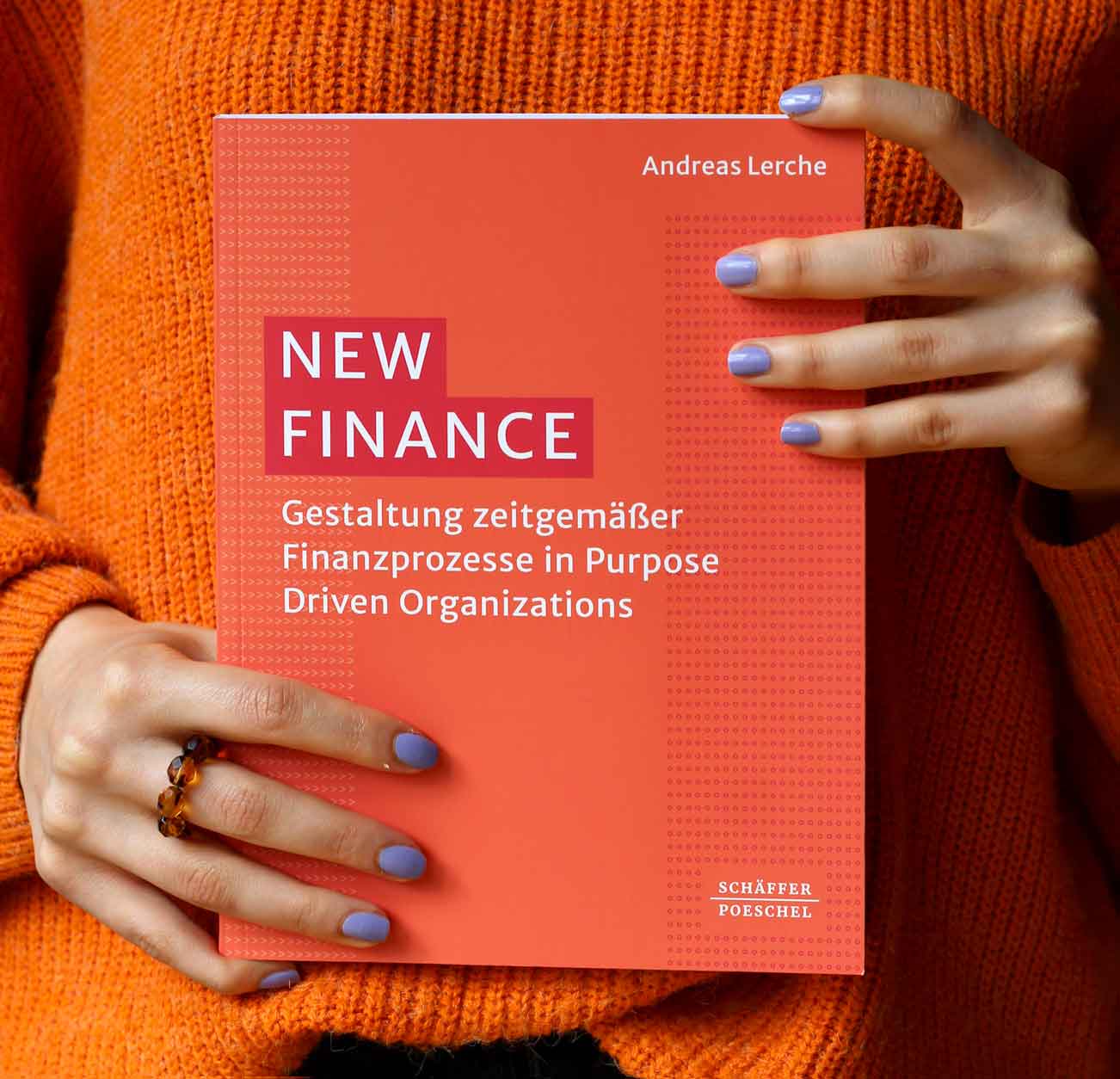
New Finance
This text is an almost criminally brief simplification of New Finance. That’s why Diver and finance expert Andreas Lerche wrote a book about it.
We knew that the methods of traditional controlling wouldn’t get us any further at TheDive. Unfortunately, the search for new concepts or ideas for finance and controlling in purpose-driven, self-organized organizations has not been particularly fruitful either. That’s why our finance guru Andreas took matters into his own hands. In his book “New Finance,” he shows how internal accounting and economic self-governance can work in self-organization.
At its core, the New Finance approach consists of five principles and seven core methods. Its goal is to create formats for communication, observation, and reflection in order to make helpful decisions that ensure the organization’s survival within the context of its relevant environments.
- The role of the Circle Economist: enabling decentralized governance
- Value Creation Accounting: measuring impact
- System–Environment Reflection: reflecting on the exchange of value
- The Economic Loop: understanding numbers and turning them into action
- Economic Decision-Making with Head and Heart
- Relative Targets: survival and success are relative
- Economic Weather Forecasting: preparing well today for the future

When we talk about changing how we look at numbers, we don’t mean inventing new measurement methods, sophisticated KPIs (Key Performance Indicators), or flashy dashboards. Rather, it’s about looking at economic relationships with a healthy dose of common sense.
If you do that, you’ll notice that it very often comes down to handling contradictions and circular relationships, and we rarely deal with predictable cause-and-effect, means-to-an-end relationships. You’ll also discover a highly powerful social construct that underpins almost all of our economic activity—and interestingly, is rarely discussed: ownership. (More on this here)
On the other hand, a radical shift in perspective also means reflecting on the reality-shaping impact of our economic language, the foundations on which we base economic decisions, and which of these “social techniques” are still useful in today’s world.
One of the central methodological building blocks of the New Finance approach is Value Creation Accounting (Wertbildungsrechnung, WBR). WBR is an internal accounting system. Unlike traditional contribution margin accounting in classic controlling, it does not calculate “top-down” (as in costs reducing profit); instead, it maps value flows. Naturally, this requires different terminology for these value flows.
While traditional accounting frameworks typically focus on tracking and reducing costs, Value Creation Accounting completely does away with the concept of costs. Cost centers become value circles, costs become prices for services, personnel costs become “colleagues’ income.” Instead of profits or losses, we observe debt reduction or debt accumulation. These are all conceptual distinctions that make a difference. As Götz Werner—the founder of the dm drugstore chain, who passed away in 2022—put it: “I have never seen a company where employees reduce the result. No, it’s always the other way around: employees bring the company’s results into being! That’s something completely different!”
Another major innovation of New Finance is the establishment of economic roles as a prerequisite for decentralized decision-making. At TheDive, we created the role of Circle Economist for this purpose, which is a standard role in every one of our circles. We distinguish between “business circles” (direct value-creating circles) and “support circles” (circles that provide internal services). The Circle Economists from all circles are organized across the organization in a guild.
And here is what the role looks like in detail:
Enabling economic success through responsible decision-making
- Serves as the first point of contact for economic questions within the circle and acts as the link to the Finance Circle
- Ensures that the established relative targets are regularly monitored and reflected upon
- Makes sure all circle members adhere to data maintenance agreements and holds colleagues accountable for keeping data up to date (the necessary basis for all financial analyses)
- Understands the numbers and core methods of the New Finance approach (Value Creation Accounting, the Economic Loop, economic decision-making, economic weather forecasting) and ensures their basic understanding and application within the circles
- Develops additional circle-specific reports and indicators where needed
- Understands value flows and how the accounting system is embedded in the organization
- In support circles, creates service catalogs for business circles and processes economic tensions with Circle Economists from other circles
- Provides economic feedback as part of the compensation process
About once a month.
The role should be filled relatively stably, as it requires both knowledge and intuition for the circle’s numbers and for the organization as a whole.
The introduction of the Circle Economist role has had a number of fundamental effects. Some of them are already clearly visible today:
- It promotes economic self-governance within the circles, because—complemented by circle-specific value creation accounting—the circles have everything they need to make responsible economic decisions.
- It increases economic expertise and knowledge across the entire organization, because Circle Economists are responsible for familiarizing all members of their circle with the basics of the New Finance approach.
- It creates a culture that fosters co-intelligence, because both at the circle level and among the Circle Economists, there is a regular exchange and alignment of individual (economic) realities.
- And finally, practically speaking: budgeting is passé! No more elaborate budgets are being created that no longer match reality after just a few weeks, yet still wield more control power than the actual reality in many organizations. Instead, economic decisions are made where the most expertise resides, with the confidence that the organization as a whole has everything it needs to make those decisions responsibly.
You can probably tell: in this article we can only touch on a few essential aspects of the New Finance approach. For anyone who wants to go deeper, we gladly refer you to the New Finance Buch.
At TheDive, we have now been working consistently with the New Finance principles and methods for over a year. What we can say from our practical experience so far is this: the New Finance approach provides a new, field-tested, holistic concept that fits the economic challenges of our time and offers new possibilities for economic self-governance beyond the traditional, linear assumptions of established controlling.
Even if it’s sometimes challenging to change such fundamental ways of working, it’s worth it. Because if we truly want to operate regeneratively, we won’t be able to avoid engaging with these topics—topics that lie at the “deep design” of every organization.

Fair, transparent, self-determined salaries: How is that supposed to work?
We developed a new process designed to make our salaries fairer, more transparent, and more self-determined—and to make our organization more regenerative.



New things are constantly emerging at TheDive.
With our newsletter, you’ll stay up to date.

New things are constantly emerging at TheDive.
With our newsletter, you’ll stay up to date.