Favorite Tool:
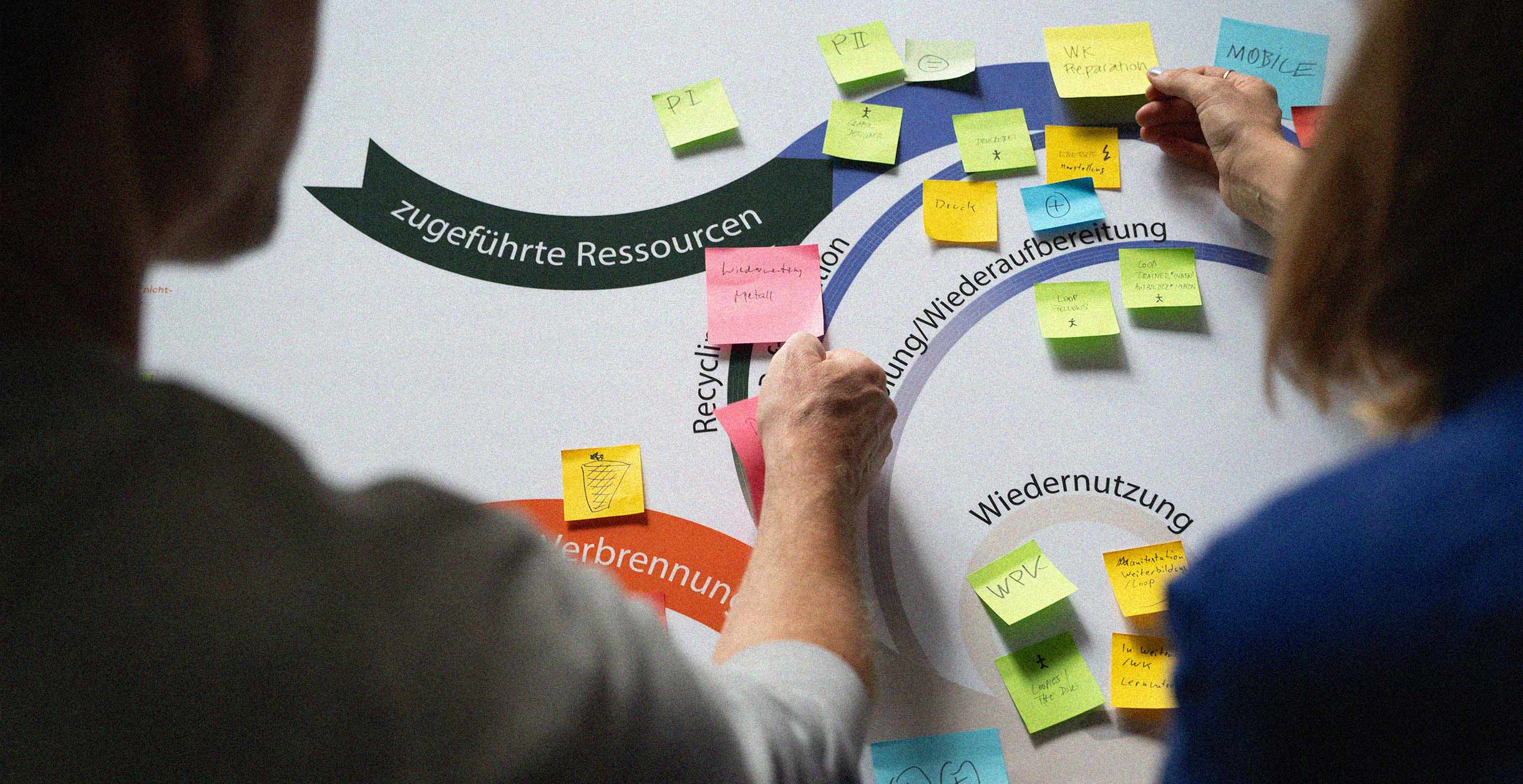
A regenerative economy thrives on the quality of relationships between all parts of a system. Regenerative organizations are aware of these interdependencies and actively invest in strengthening the quality of these relationships. In the Stellar Approach we therefore take a closer look at the relationship system in which a team or organization operates, and explore regenerative design possibilities.
It is important to keep a clear view of the interplay between your own sphere of influence and the dependencies that arise from decisions made elsewhere in the organization—or even outside of it. Regenerative teams know their own sphere of influence and use it to contribute their own impulses to a regenerative transformation. They are also aware of where their Circle of Influence ends and how to deal with ideas that lie on the edges of their influence.
With this differentiation in mind, we take a closer look at the team’s value creation process. To bring clarity to the relationship system the team is embedded in and to identify potential improvements, we use the Regenerative Business Canvas. This tool builds on foundational models of circular economy, which we have adapted for our purposes.
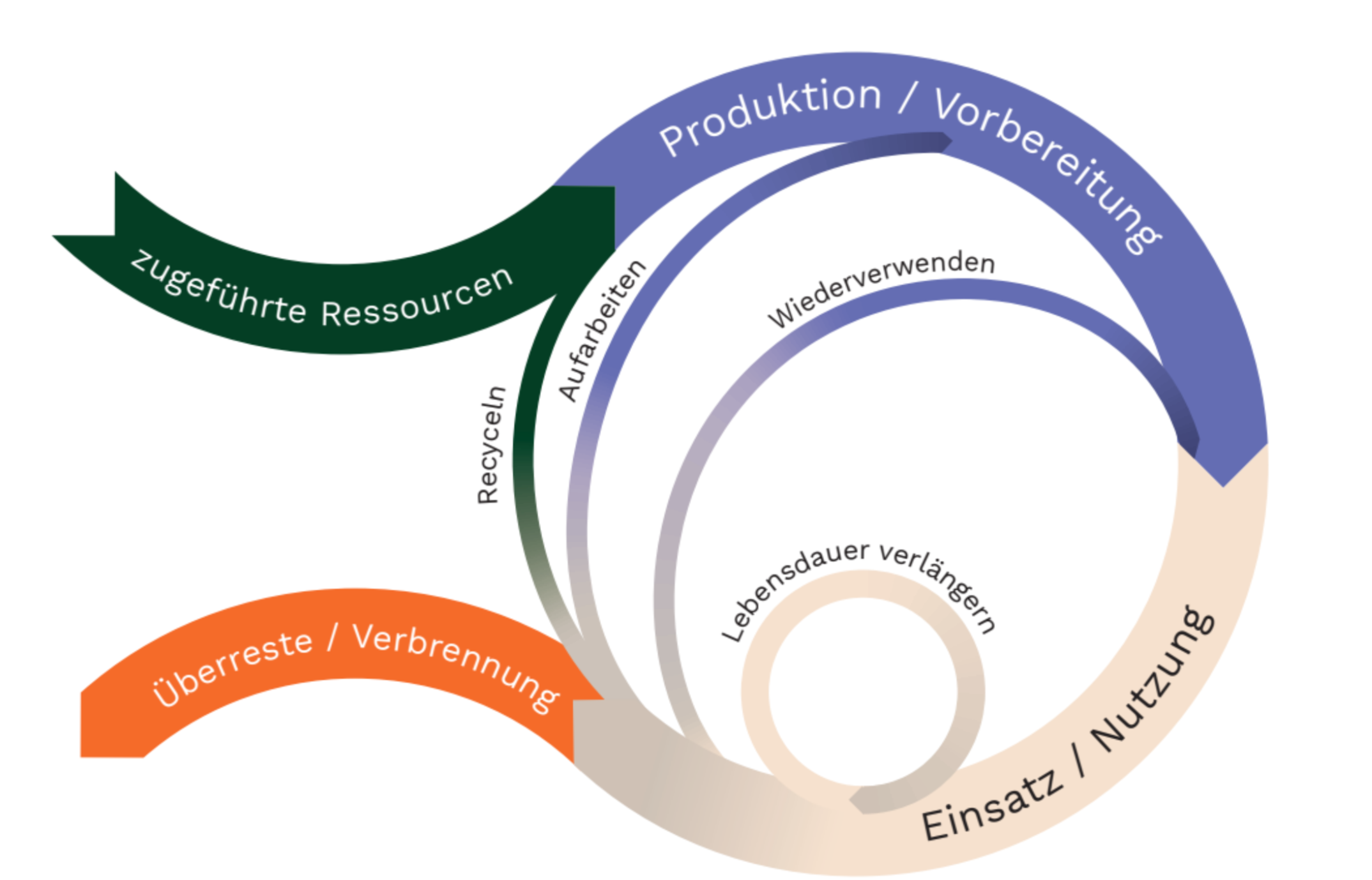
The Regenerative Business Canvas (RBC) distinguishes four phases of a linear value chain, as well as four different ways to close loops. To make this easier to understand, we provide an example. The example aspects are of course not exhaustive—they are merely illustrative material showing how the tool can be used.
What do we need to deliver our value, and where do we source it from? This can include financial resources, people’s time, materials, energy, and technology. And in which broader contexts are these input resources embedded?
Who is involved in producing our products or affected by their production (for companies that create physical products)? Who is involved in preparing for use or affected by this preparation (for companies that provide intangible services)?
Who or what is affected by the use of our products or services?
Which parts of our product or service delivery remain in the value chain that are no longer usable?
- How is the lifespan of the product/service extended? With what means do we intensify usage so that fewer products need to be produced overall?
- Is the product passed on for further use after it has been used?
- Which parts of the product are refurbished and put back into use?
- Which used raw materials are reused through recycling?
The team has a clear overview of all human and non-human stakeholders involved in value creation and identifies initial action options.
We use the RBC model to gain an overview, in the following six steps, of all stakeholders involved in value creation, to describe our impact on these stakeholders, and to identify initial action options. Depending on the team size, we work either in small groups or as a whole team.
Step 1
The team sketches the lifecycle of its current value creation using Post-its along the phases of the RBC. The key steps of value creation are assigned to the different stages of the value chain, as described above. We only look at the present state of affairs—nothing else!
Step 2
The team collects, along the stages of the RBC, all stakeholders (people or natural entities such as the local water system, fauna, etc.) with whom it has a relationship during the value-creation process. The team also considers who or what is indirectly affected (for example, employees’ families, stakeholders along the supply chain, or natural systems in locations where necessary raw materials are produced).
Many teams can explore their environmental systems in great detail here, which can quickly lead to overwhelming complexity. That’s why we initially stick to whatever comes up within 10–15 minutes. The work with the model can be deepened later if needed.
Step 3
The team evaluates the impacts its value creation has on each stakeholder. We differentiate between social and ecological impacts and use a simple scale from -2 to +2.
It is recommended to start with stakeholders whose impacts are easy to measure quantitatively or assess qualitatively. If more precise data is needed to evaluate impacts more accurately, this exercise can generate follow-up tensions, which are then collected in the tension backlog.
Step 4
The team marks the Post-its in the RBC where it recognizes particularly urgent action is needed, creating a heat map. Additionally, the team identifies points in the RBC where quick wins are possible—i.e., changes that can be implemented with relatively low effort.
Step 5
Finally, the team records the to-dos and next steps. At this point, it is possible that some tasks are moved directly into the sprint backlog, especially if they are intended to be worked on in the first sprint between Module 1 and Module 2.
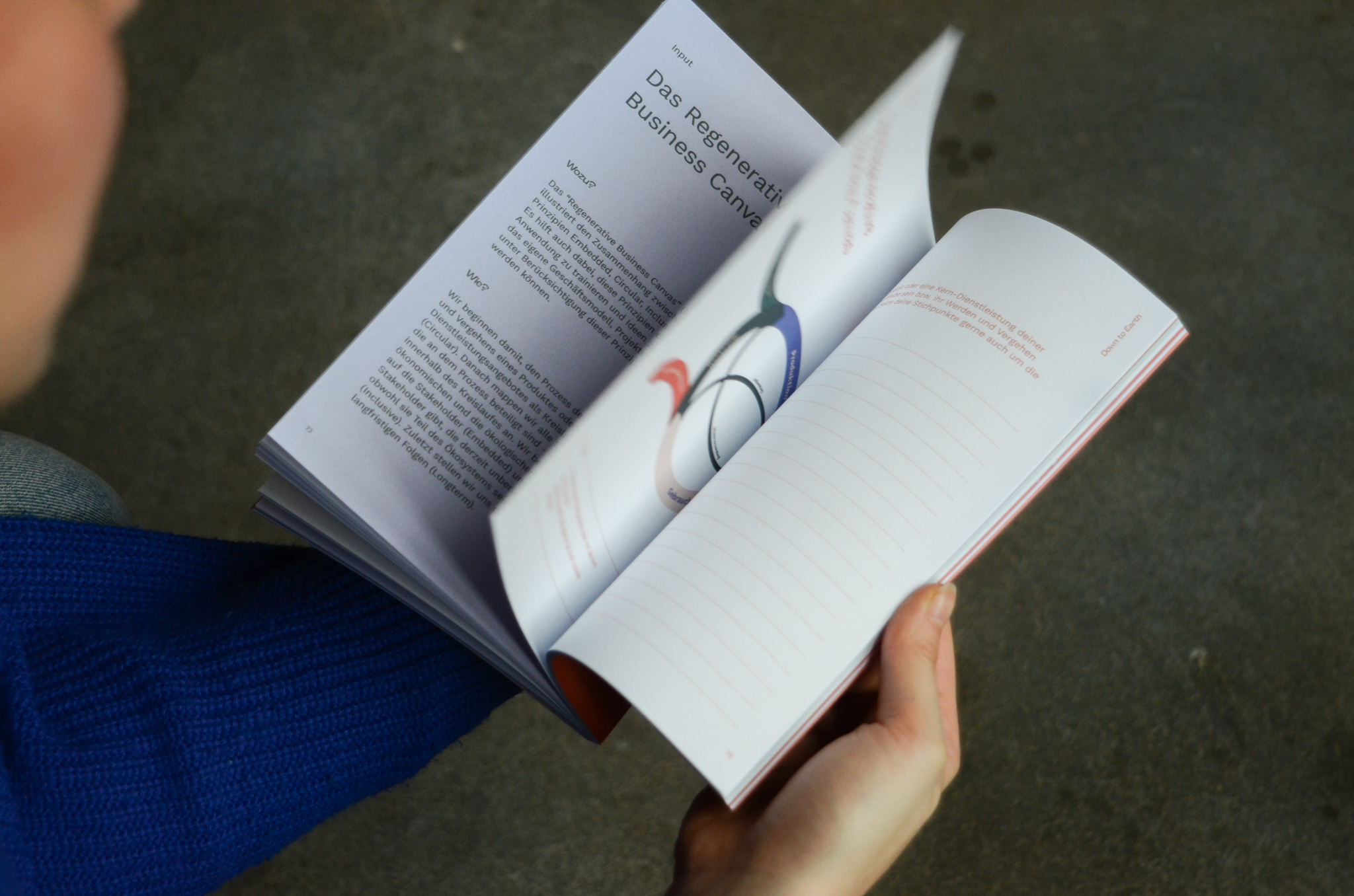
Free tool available for download
With our free PDF, you can explore the Regenerative Business Canvas on your own. The best way to use it is to upload it to one of your favorite collaboration tools—like Mural, Miro, or similar. Enjoy!



New things are constantly emerging at TheDive.
With our newsletter, you’ll stay up to date.

New things are constantly emerging at TheDive.
With our newsletter, you’ll stay up to date.