Why Regenerative Economy is the most important Topic

As economic actors, many of us have lived for decades inside a fiction. The convenient belief that the economy is a closed system, and that the market holds the primary answer to all questions of progress and development, has held society firmly in its grip. Some people already began warning in the early 1970s, but they were — and sadly still are today — accused of simply not trusting the regulatory forces of the market enough.
The problem then, as now, is that “the market” has never fully worked, because not all relevant information is accounted for in market processes — no matter how existentially important it is. If we had priced natural resources into the cost of goods from the beginning (including the damage we inflict on them), it could have worked. But resources like water and air were often available for free. While profits were increasingly privatized, ecological damage was pushed onto the public sphere. The problem that we neglected these so-called “negative externalities” for so long (a deceptively technical term that barely captures the monstrosity of its meaning) is now coming back to us with full force. The universe strikes back.
And now? We’ve talked about sustainability, CSR, and most recently ESG for so long that sustainability no longer seems enough. Wait, what?! Unfortunately, we have pushed the planetary boundaries so far that sustainable behavior — in the sense of “not causing further harm” — still won’t put us on a 2-degree pathway, let alone anything below that.
We all know time is running out. We have just under 10 years to cut global CO₂ emissions in half, and then about 15 more years to bring them down to zero. More and more people are becoming aware that this is increasingly a question of life and survival. Probably not the survival of today’s 50- or 70-year-olds. But definitely the life of today’s 20-year-olds. And possibly the survival of those being born right now.
In times of crisis, humanity has proven again and again that it can come together and pull in the same direction. Even if it sometimes feels like the opposite right now, we can still make it — if, yes if, many things happen at the same time. If politics sets the right framework and the right incentives. If innovation and development are guided in useful directions. If courageous people step forward, even when their ideas sound completely absurd and crazy by old standards. It’s usually those who were initially considered crazy who, in hindsight, make the difference.
It’s no longer about blame or about what responsibility the private sector had for the situation we’re in today, or what responsibility it will have in reshaping our planet. Everyone is called upon in their respective fields to pick up a shovel and bucket (or seeds and a watering can) and help build a new world that is more regenerative, more inclusive, and more just. The fact that over 200 companies have already joined the Climate Pledge and committed to “Net Zero Carbon” by 2040 (well ahead of the timeline demanded by the Paris Agreement) shows that this internal orientation has already arrived in the business world. Climate Pledge
This disruption will happen in giant leaps over the next few years. It’s no coincidence that political leaders are currently talking about the biggest transformation in industrial history. If digital disruption or agile disruption already felt fast, regenerative disruption will feel like supersonic speed. It has to do with the exponentiality everyone keeps talking about. If we want to arrive in a more regenerative world in 10 or 20 years (and again: this is not optional), then companies will look very different in just five years. In other words: whoever starts now can be five years ahead — a difference that may decide not just success, but survival. In this case, the survival of the company itself.

We humans are not alone on this planet. If you scale Earth’s 4.6 billion-year history down to 46 years, humans have only been around for four hours. The Industrial Revolution (and with it modern economic history) began one minute ago. And in the last 30 seconds, we’ve destroyed more than 50% of the resources available to us — in some cases irreversibly.
What is becoming increasingly clear in light of the advancing climate crisis is this: humans depend on this planet. Without it, there are no humans. And without humans, there is no economy. In that order. The economic system is embedded within life-supporting systems — whether social or ecological.
If we destroy these systems through the way we do business, it no longer matters whether GDP is rising or falling. It also no longer matters whether we’re still creating jobs or not. Because the world in which those jobs are supposed to exist will no longer be able to sustain the lives of the people doing them.
Yes, this sounds like a radical reprioritization. And after decades in which economic profit has been the primary measure of success, it may feel counterintuitive. But in the medium term, the only sensible purpose for companies will be to create positive solutions through their economic activity and to contribute to preserving intact ecosystems — or regenerating those already damaged.
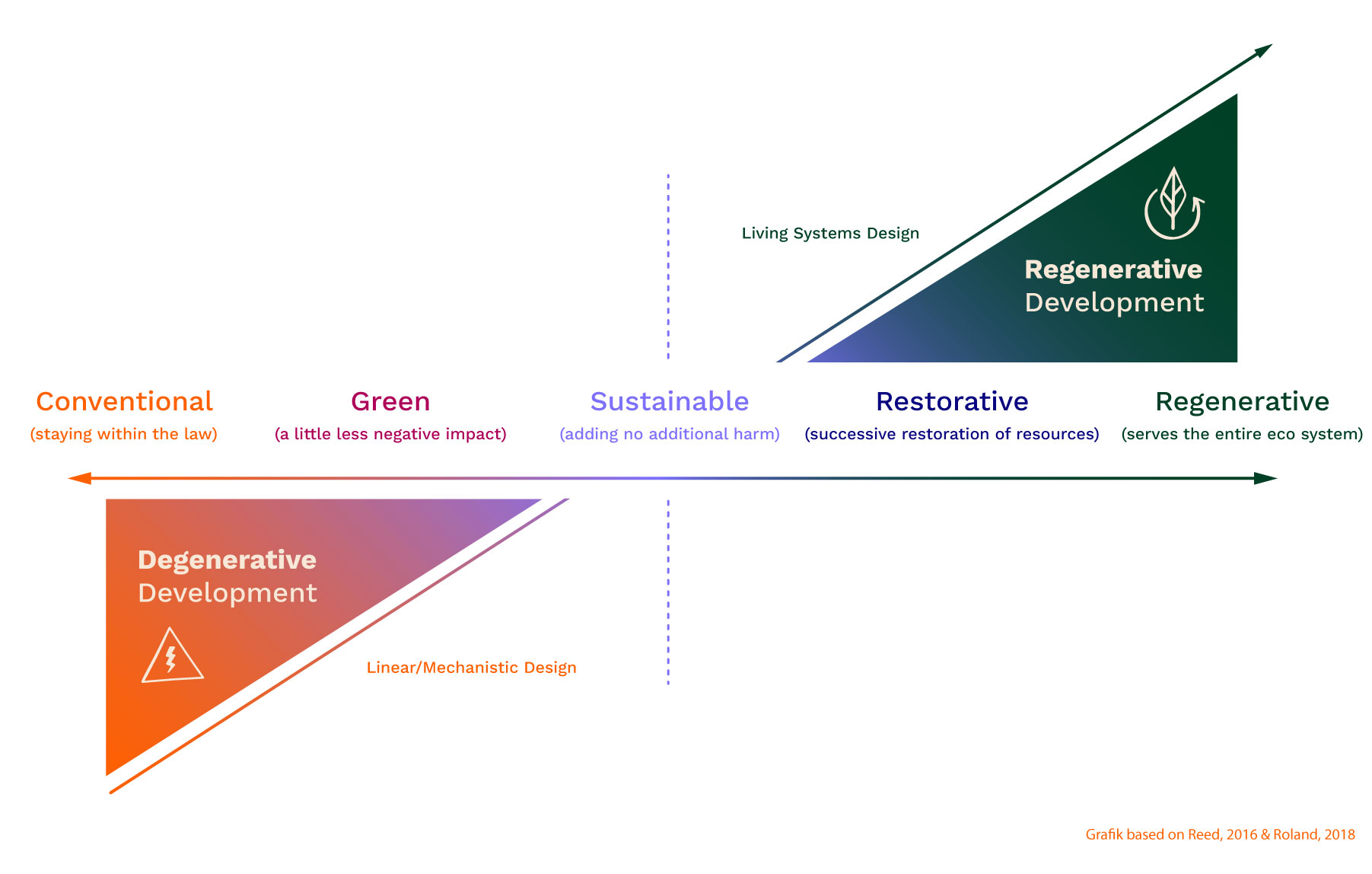
In this sense, regenerative economy is nothing more than radical user orientation — assuming, of course, that the “users” actually have an interest in the survival of humanity. The difference between Human-Centered Design, as it is widely practiced today, and a regenerative approach to user orientation (some may call it “Beyond Human-Centered Design” or “Planet-Centered Design”) lies in systemic thinking and a stronger long-term perspective. Solutions that meet current user needs but become part of the problem in five, ten, or twenty years will eventually turn against their users — and therefore against the business model of the provider.
If you also factor in the sharply rising costs of socio-ecological crises over the coming years (both at the societal level and for each individual company), the costs of inaction, and the changing regulatory landscape, then pursuing a serious transformation toward regenerative business practices becomes an economic imperative as well. Strangely enough, the companies that start rebuilding themselves regeneratively now will be the ones that are most economically successful in the future — precisely because of this shift. At first, it may feel like an additional investment. But with a bit of distance, it becomes an investment in your own survival. And the only chance we have.
In the era when we still believed “sustainable” could be enough, organizations began creating dedicated departments for it. They were called Sustainability Management, Corporate Social Responsibility, or something similar. And there is absolutely nothing wrong with that. The problem is that siloed structures like these rarely change the core business, let alone the entire organization. And that is exactly what is required now. When the house is on fire, it doesn’t help much to put out one room and then pat yourself on the back for having the blaze under control.
Many sustainability managers, by the way, suffer from a lack of speed and limited impact, even though many of them are doing this work out of deep conviction.
To be digital, you need digital habits across the entire organization. To be agile, you need agile habits across the entire organization. And to be regenerative, you need regenerative habits. Across the entire organization.**
When it comes to digital and agile, most people understand this (even though many organizations still struggle with it). The era when digitalization was treated as a vertical function is thankfully over. And companies that still handle it that way today are likely facing major transformation problems by now.
Sustainability or regenerative business is still seen in many organizations as purely a strategy, reporting, communications, or CSR topic. There’s nothing wrong with any of that — but it won’t be enough if we want (or need) to transform the entire company in a very short time. This requires a synchronized approach and active involvement from every team across every area. And here the circle closes with many themes that have gained far more attention in recent years under the banners of New Work or Future of Work. Such a task can only fail under a “command and control” logic. Organizations that have spent recent years rethinking leadership, building more lateral structures, and becoming more agile and responsive are now at an advantage, because the idea of “everyone contributes where they can, guided by a compelling purpose” — within a clear and yet adaptable process — lands on much more fertile ground. (Lovely — another regenerative metaphor!)


The Stellar Approach



New things are constantly emerging at TheDive.
With our newsletter, you’ll stay up to date.

New things are constantly emerging at TheDive.
With our newsletter, you’ll stay up to date.