Stellar Principles

Like everything in life, holistic regenerative business has both an inner and an outer dimension. So it’s not just about regenerative strategies, processes, and structures — it’s also about regenerative cultures and mindsets. Regenerative practices start at the individual level and can be described at the team and organizational level as well.
But the first question for us is: what exactly do we mean by “regenerative organizations”? How can this concept be made manageable and operationalized for organizations? What is the real difference between conventional business models and regenerative business models?
In our Stellar Approach we developed four principles that answer these questions. The four Stellar Principles can be applied to strategy, processes, and culture — at the individual, team, and organizational level.
Embedded
The interdependencies with other (human and non-human) stakeholders are structured so that the positive impact outweighs any potential negative impact.

Living systems derive mutual benefit from the value-creating relationships among their components. Our planet functions as an immense ecological network in which every element interacts with others and contributes to the cycle of life. Bees that collect nectar while pollinating plants, squirrels that disperse seeds, and fungi that not only support communication among plants but also aid in decomposition are just a few examples from the endless list of living synergies.
These principles of interdependence and cooperation also apply to humans as part of this global ecosystem. As social beings, we do not survive through competition, but through cooperation — both with one another and with the natural resources our lives depend on. It is essential to recognize that we do not exist in isolation, but live within a network of dependencies. Actively nurturing our environments is therefore not just an act of goodwill; it is a fundamental necessity for our own survival.
In the context of regenerative business, this interdependence means we must consciously include all stakeholders — both human and non-human actors — in our considerations. It’s about actively cultivating and improving the quality and well-being of our relationships with these stakeholders, because our economic actions directly affect them.
Diverse
Our actions promote inclusion and leverage diversity to strengthen the resilience of our organization.

Life needs diversity. It is diversity that secures survival, because it increases options and thereby strengthens the resilience of the overall system. The importance of diversity becomes particularly clear when nature is deprived of it. The practice of monocultures in agriculture illustrates the severe problems that can result from a lack of diversity: pests, the forced use of pesticides with far-reaching negative environmental effects, exhausted soils, species loss, and the rise of pathogens that affect plants, animals, and increasingly humans.
Diversity and inclusion are fundamental to regenerative transformation. Excluding certain social groups means their potential contributions to society are missing, which results in repeating existing approaches rather than developing new innovations. Climate activist Elsa Mengistu emphasizes the need for an intersectional approach to environmental protection: environmental work must also be anti-racist in order to reach not just part of the population.
Diversity is also important from a business perspective. Companies that rely on too few suppliers are exposed to risk. Firms that fail to meet the needs of a diverse society lose relevance.
Within regenerative business, diversity means considering a broad range of societal perspectives. It is about raising awareness of groups that could be marginalized by economic activity and seeing the inclusion of these diverse viewpoints as a central factor for organizational resilience.
Circular
In all of our products and services, one cycle feeds into the next. Our responsibility extends across their entire lifecycle. We recognize that thriving means acknowledging that everything in this world not only has a beginning, but also an end.

The fundamental form of life is circular and cyclical. It consists of constant becoming and passing away. The counterpart to birth is death; together, the two describe the process of life. Even this life that unfolds while we are reading this book will one day come to an end. The many generations that follow us in time will then carry the larger life process forward.
The principle of circularity illustrates particularly clearly the conflict between today’s economic system and the natural systems of our planet. The fundamental pattern of life forms a closed loop, while the basic model of the modern economy is an endlessly rising line. Harmonizing these two fundamental patterns is essential to securing a livable environment in the long term.
Growth also exists in nature, but unlike economic growth, it includes the transition from the old to the new—a process that creates fertile ground for new life. This distinguishes mere growth from flourishing, in which decay is understood as an integral part of the process.
The cyclical nature of life also means that it is shaped by rhythms: day alternates with night, wakefulness follows sleep, growth gives way to composting. The same applies to working life, which is also governed by rhythms. We cannot be productive all the time; productive phases must be balanced by periods of recovery. Regeneration cannot be postponed.
In regenerative organizations, the principle of circularity is applied in many different ways. How can we close loops within our business models? How do we work with resources in ways that honor principles of renewal and regeneration? This perspective extends beyond materials or services to include the energy that each employee contributes to the organization.
Long-term
Wir berücksichtigen die langfristigen Auswirkungen unseres wirtschaftlichen Handelns.

Although every single element of life eventually ends, the overarching life cycle shows no foreseeable end. It is possible that the universe could collapse into a state of extreme density in the distant future, but even in that scenario it remains uncertain whether that would mark the end of all life.
Our current economic system demonstrates remarkable short-sightedness regarding its long-term consequences. The growing dominance of financial markets and the increasing financialization of the economy have further amplified this tendency toward short-term thinking. The time structures that shape our economic system only partially align with the time structures of the natural systems on which our survival depends. In particular, we have failed to give ecosystems sufficient time for necessary regeneration, which has led to critical neglect over the past decades.
For regenerative companies, a long-term time horizon implies that decisions must be made beyond quarterly results and in the context of generations. What consequences will our economic actions today have for future generations? In what ways can we adjust our actions in the present so that, if our company or organization succeeds today, it represents a positive legacy for those who come after us?
With the Stellar Principles, we can describe where the regenerative journey is headed. They provide an answer to the question of which core principles should be considered when designing regenerative, long-term resilient organizations.
That leaves the question of how we can begin moving in that direction. With the Stellar Approach, we have developed a process framework that provides orientation in this transformation.
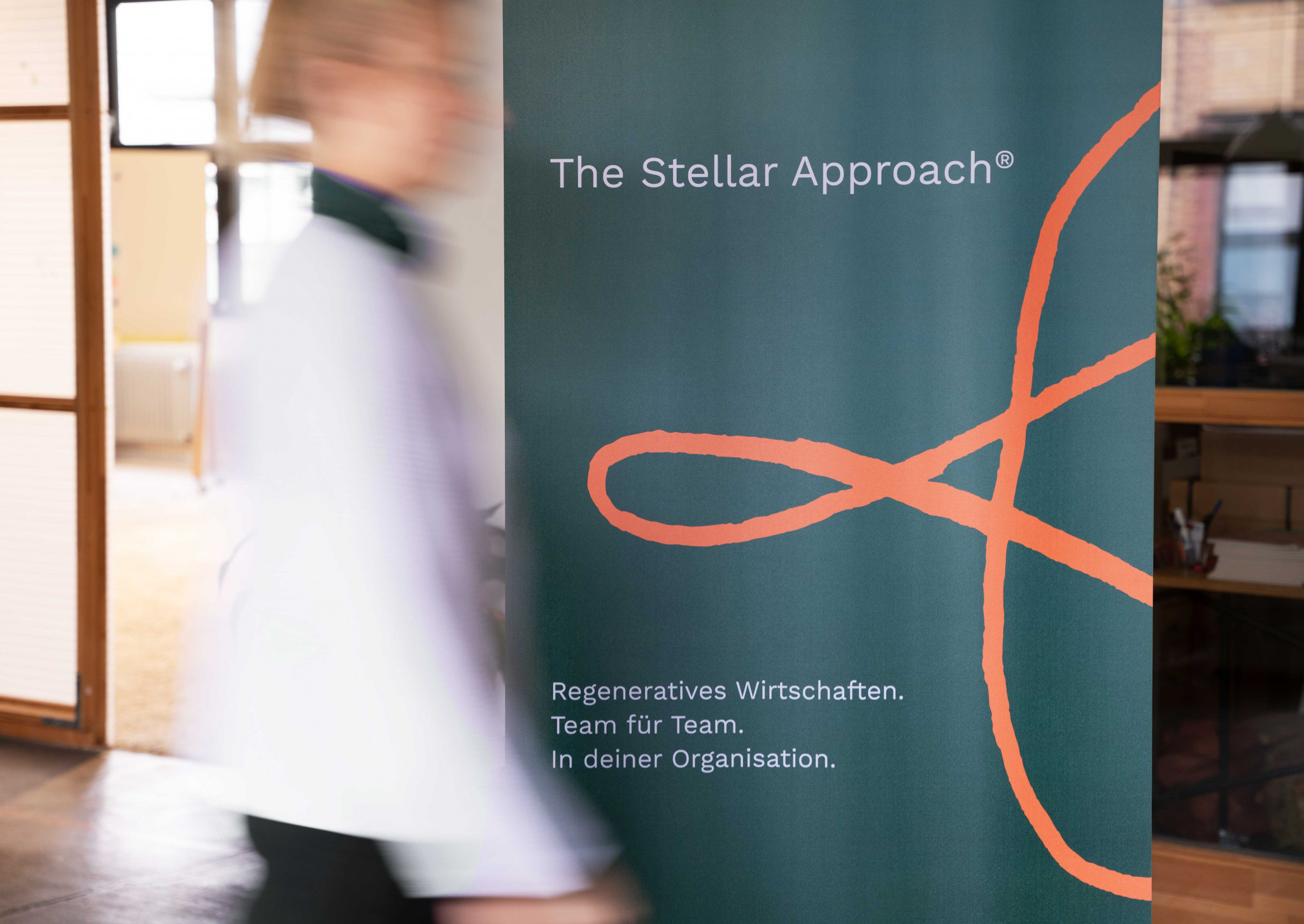
The Stellar Approach®




New things are constantly emerging at TheDive.
With our newsletter, you’ll stay up to date.

New things are constantly emerging at TheDive.
With our newsletter, you’ll stay up to date.