The Life-centric
Here we are. In a world where forests burn every summer and rivers dry up. In a world where many natural ecosystems are seriously ill. In a world where a small number of extremely wealthy people own as much as the poorest 50 percent of the global population. In a world where the richest 1 percent produces twice as much CO₂ as the poorest 50 percent. In a world where violent conflicts are on the rise again. In a world that we have largely created ourselves.

It is clear that “the economy” has contributed significantly to these crisis conditions and continues to do so every day. Unrestrained and exponential economic growth and the endless productivity it requires are accelerating the already set path. Given the realization that time is running out to counteract this, and that we may have already passed a number of tipping points, the call for systemic change is growing louder—from NGOs, but also from governments and supranational institutions.
The problem has long ceased to be at the level of knowledge. We know the numbers. We have sufficient empirical evidence. We know the state of our global society. There are also clear scenarios for how we could break into a new world, what a new social and economic paradigm could look like. Just recently, in September 2022, the Club of Rome published the “Earth for All” study, which identifies five major economic turning points and outlines the most important measures for each of them. Taken together, all these measures would cost us between two and four percent of global GDP. A huge sum, no question. But absolutely feasible.
We already have enough knowledge. We also have enough money. Yet we still don’t take action — Otto Scharmer calls this the “knowing-doing gap.” So why is that? Of course, there are many people in the world who, out of self-interest or sheer overwhelm, choose to look away from the state of the world, label it as fake news, or continue to believe that a single technological fix will save us.
But another compelling answer for why we don’t move into action comes from systems theory (and unfortunately, we can’t avoid a very brief theoretical detour here).
Systems theory distinguishes between organic, psychic, and social systems and how they function. Companies — and the economic system as a whole — belong to social systems. We as individuals belong to organic systems (our bodies) and psychic systems (our consciousness). No matter what kind of system it is, systems always strive to preserve and reproduce themselves. And our economic system is really good at doing this. So good, in fact, that the problems at the edges of this system keep growing bigger and bigger.
From a systems-theory perspective, a system’s ability to sustain itself is limited by the environments it is embedded in. This is called co-evolutionary embedding. In other words: if a system keeps reproducing itself more and more, but in the process damages the environments it depends on for survival, then eventually its own reproduction will also stop.
In organic systems (plants, cells, etc.), necessary course corrections usually happen because the surrounding environmental systems eventually put a stop to the uncontrolled spread of a single system. In social systems, the corrective mechanism is most accurately described as “voluntary self-restraint.” This doesn’t only refer to voluntary actions by individual actors, but also to the frameworks and laws that the system creates for itself in order to coordinate and secure its survival.
It is precisely within this tension that the crises arise that the economic system fuels day after day: the economy works extremely well as long as we look at it through its own system logic (growth! full employment! multiplying money!). But it fails dramatically when it comes to becoming aware of its mutual dependencies with other relevant environments and behaving co-evolutionarily — meaning: striving to ensure that all systems can thrive together.
We need new rules of the game—for individual companies and for the economy as a whole—that actively encourage voluntary self-restraint in favor of the environments we’re embedded in as humans, organizations, and economies. But we can’t just hit pause, take a moment to design a new social and economic blueprint, and then restart the game under a new rulebook. Instead, we’re being asked to carry out this urgently needed transformation while the system is still running.
To pull off this massive and crucial shift (the Club of Rome fittingly calls the corresponding scenario the “Giant Leap”), we need united forces in the form of collective action. That means working on the system itself: evolving and reshaping legal frameworks, incentive structures, and political steering mechanisms. This is where people in political roles—those who can change regulatory conditions—are needed. With all the competing special interests out there, especially on a global scale, this can be a slow and difficult process, as COP27 unfortunately reminded us.
At the same time, we need change within the system itself: companies that begin to take the interdependencies they are embedded in seriously and take responsibility not only for themselves, but also for the vital surrounding systems they depend on.
We need companies that understand that “voluntary self-restraint” is necessary in order to enable the neighboring systems — and therefore, in return, ourselves — to survive. You could call that something like “interdependence competence,” even if the term sounds a bit clunky.
Interestingly, we’re already in the remarkable situation where some actors within the economic system are calling on politics to change the framework conditions more consistently and more quickly in the way described here. On the occasion of COP27, more than 100 CEOs and senior executives wrote an open letter to political leaders, reaffirming their willingness to collaborate in order to accelerate the transition to “net zero.” That makes perfect sense: as long as everyone else is still taking advantage of the freedoms of the old rules, I don’t want to be the only one who has to follow the new ones. Once the same new rules apply to everyone, it gives me, as a business leader, the certainty I need to act and invest for the future.
One of the most important rules that needs to change is our definition of “success.” As long as we stay within the narrow boundaries of the current economic system and ignore our dependencies on other systems, the only metrics that count are economic ones. A successful company is one that is profitable, grows its net worth, and delivers dividends to its owners or shareholders. End of story.
In a new economic paradigm, this definition of success is expanded to include what we might call “interdependence competence” — the ability to consciously embed your organization in a co-evolutionary relationship with its environments. And to be clear: this isn’t an either/or. It’s a both/and. Of course companies in the private sector still need to be financially healthy to survive. But alongside that, they need a contextual mindset — an understanding of interdependencies and feedback loops that is at least as important for long-term survival. This kind of thinking not only strengthens the resilience of individual organizations, but of the entire economic system. It’s a shift from linear thinking to systems thinking. Applied systems thinking, if you will.
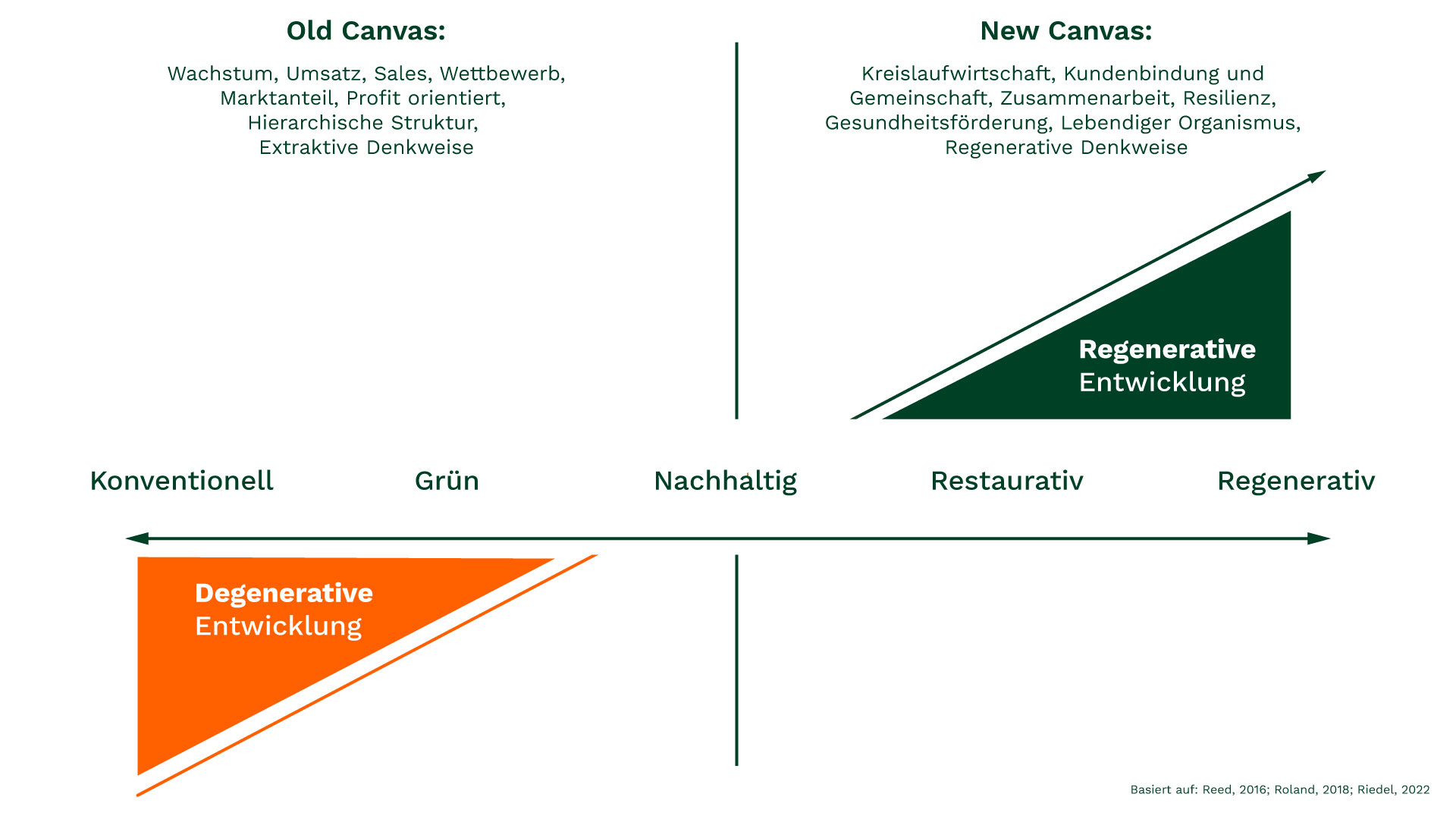
If we look closely, this new paradigm is already showing up in many places — even though it’s not yet embedded in the mainstream or something we can take for granted. Increasingly, people within the economic system are experiencing a strange gut feeling: they’re still focused on financial metrics, but they can’t ignore the daily crisis headlines. The growing importance of sustainability indicators, and the fact that environmental, social, and governance criteria are already becoming mandatory in reporting standards, are early, tentative signals of this new paradigm. We’re far from a point where social and ecological systems feel stable again, and progress is unfortunately too slow in many areas. But there are observable artifacts of the “new” that give us a first taste of what a possible future could look like.
Just to quickly recap: we now need rapid and decisive work on the system and within the system. We can’t wait for each other.
It’s tempting, given the scale of the changes needed, to look to politics first and call for new regulatory frameworks. And of course, those are necessary.
At the same time, every single organization is called to start moving toward the new paradigm from within itself—and thereby contribute to systemic change from the inside out.
At TheDive, we see our contribution primarily in the system—and in two ways:
On the one hand, in the way we design our own organization as a prototype of a Life-centric Organization.
And on the other hand, by supporting other organizations in developing in ways that are helpful for all of us.
In recent years, our framework for a Life-centric Organization has continued to evolved and it completes the picture. It forms the framework we’re navigating within—and the framework we’re happy to share with anyone who wants to join us on this journey. In a fairly comprehensive transformation program, we set the course in 2022 to bring the paradigms of a Life-centric Organization to life even more consistently in our own example. You can read exactly how we did this in the texts linked below.
For us, it’s about creating a short-term disruption to the system that—over the long run—contributes to the preservation of the systems themselves (both the economic system, society, and natural ecosystems). Why? Because interventions that merely aim to maintain the system won’t be enough to make a real difference.
A Framework for the Regenerative Transformation of Organizations
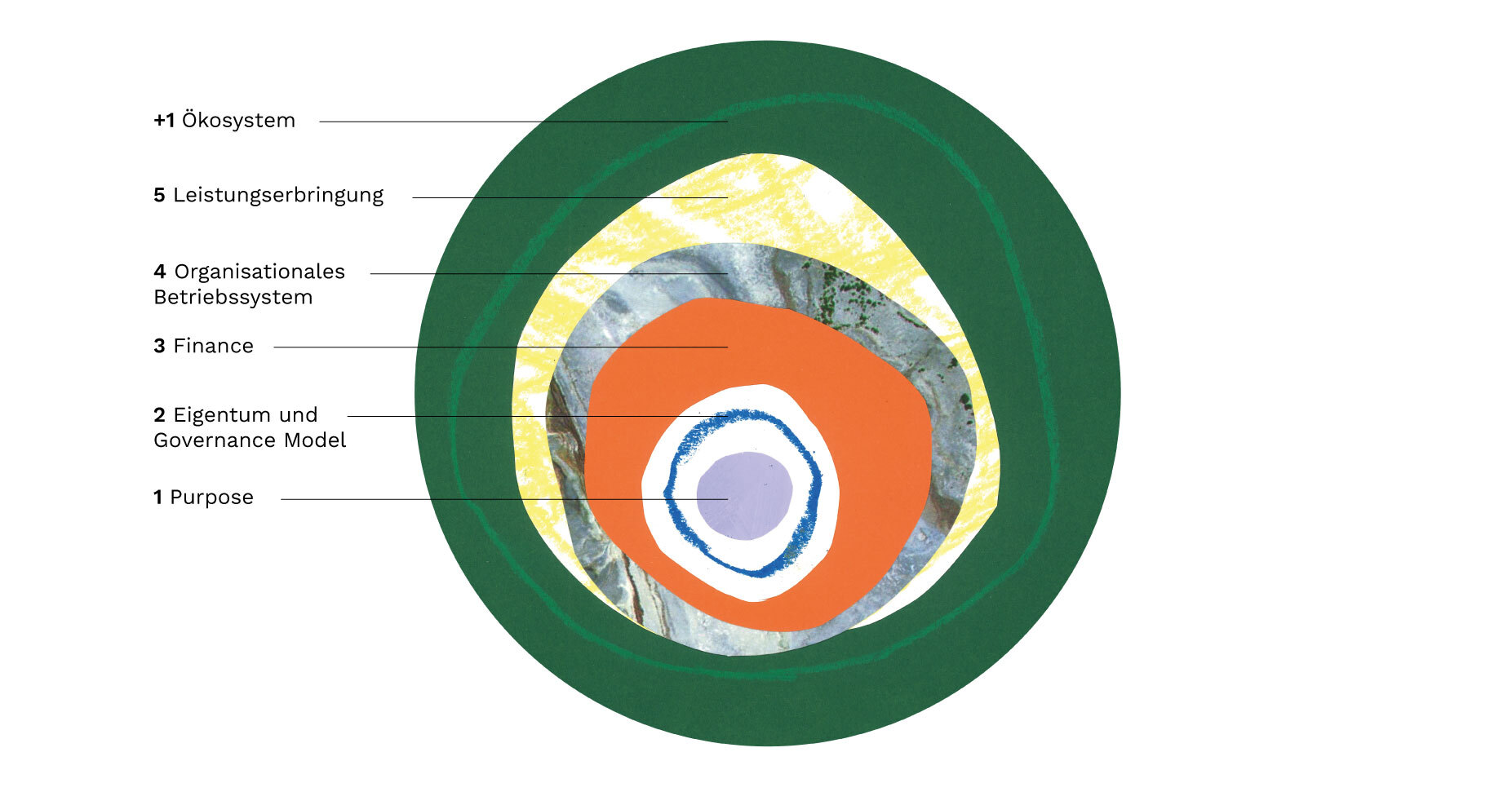
What we need are regenerative organizations—those that are aware of their embeddedness in social and ecological systems and actively create positive solutions. To preserve ecosystems that are still intact, and to regenerate those that have already been harmed. To design such organizations, we see five plus one levels that should be taken into account. Why “5+1”? Because five of these levels sit inside the organization, while the sixth extends beyond the organization’s boundaries.
1. Purpose: From profit-only to impact-first
2. Ownership and Governance Model: From short-term profit maximization to long-term responsibility
3. Finance: From “quarter is king” to “finance serves purpose”
4. Organizational Operating System: From a people-hierarchy to a living organism
5. Value Creation: From linear exploitation to reciprocal value creation
+1 Ecosystem: From competing for limited resources to co-evolution
In such an organization, two principles work against each other in a countercurrent—moving from the inside out and from the outside in: the purpose principle is balanced by the value-creation principle, and the self-determination principle finds its balance in the interdependence principle. We’ll explore how these principles interact a bit more closely below. For now, we’ll only touch on the key aspects of each regenerative organizational dimension:

Here, it is defined why the organization exists and what its contribution is to its relevant environments.
This is where the purpose principle originates. Why do we exist? Why does the world need us? How should we evolve if we realize that the world no longer (or not as much) needs us? The purpose of an organization is directly linked to its environments: events within the organization, as well as events in its environments, influence what we construct as meaningful, what we consider possible, and how we further develop our purpose.
The countercurrent to the purpose principle is the value-creation principle: in the private sector, it’s about whether others are willing to pay for the outputs that result from an organization’s purpose-driven work. If no one pays for them, the survival of the organization—and thus the pursued purpose—cannot be secured, at least within the contexts of the private sector.

Property is the central construct of our economic system. It is property that makes all the specific communications and actions we call “economic” possible. The premium of property lies in its free encumbrance, pledgability, marketability, or retention. All these operations are only made possible and protected through highly developed legal systems. It is through property that creditor-debtor relationships—and thus money—come into existence.
Many of the major challenges currently facing the economic system can be traced back to how property is managed and the resulting consequences. In particular, the increasing financialization—the fact that credit and capital markets are extending into spheres beyond the traditional financial system—would not be possible without property (e.g., to secure loans, through speculation with intangible assets such as companies, etc.). Responsible management of property—as demanded, for example, by the German Basic Law and many state constitutions—is a key to further developing a regenerative economic order.
Here, too, we are dealing with a both/and: short-term property interests may be very justified in individual cases, but they should always be balanced with a long-term orientation. Instruments such as steward-ownership or the “company with bound assets,” as referenced in the coalition agreement of the current German federal government, are very promising approaches that foreground the fiduciary character of property.
You can read about how we ourselves at TheDive approach steward-ownership and the journey we are on hier.

Continuing from the reflections on property, the next question naturally arises: how do we handle money within organizations, and what does a life-serving approach to money actually look like? Just like at the level of property, this goes into the deep design of an organization. Here, questions arise that are as fascinating as they are unsettling, such as:
How much money does the organization actually need? Is it about survival or maximizing profit? Profit for whom, and for what purpose?
If the organization is a living system, how should processes be designed to reflect the vitality and complexity of life?
The last question, in particular, will be familiar to all finance experts and practitioners. Strangely, we’ve been talking about agility and iterations for years, yet in finance, we still cling to annual budgeting routines and traditional linear controlling instruments (despite efforts from pioneers like the Beyond Budgeting movement).
At TheDive, for lack of better ideas, we also operated for a long time in a shadow world of classical finance approaches—which, unsurprisingly, only aligned to a very limited extent with our otherwise highly self-organized operating system. Since early 2022, we’ve been radically redesigning our finance processes. We are fortunate to have our colleague Andreas Lerche on board—not only a recognized finance expert but also a person with systemic insight. Andreas, our Finance Guru, has compiled his knowledge this year into a book, which will be published on April 13 by Schäffer-Poeschel under the title New Finance. The book provides not only a compelling theoretical foundation but also practical guidance on how the New Finance approach and its seven main methods can be implemented in an organization Hier könnt ihr es vorbestellen or you can sign up for the New Finance Newsletter anmelden!
If you want a first impression already, we’ve documented the experiences we’ve been having since introducing the New Finance methods hier.

At this level, the decision-making principles that guide and shape an organization are formulated. The organizational operating system acts as a kind of hinge between the internal dimensions of a regenerative organization (Purpose, Ownership, Finance) and the delivery of value outward to customers and other stakeholders.
To explore how an organization can evolve from a classic hierarchy of individuals into a living organism, we at TheDive developed our framework, the The Loop Approach®, which we, of course, also apply to ourselves. At the same time, we have the freedom to experiment a bit more radically and consistently within our own organization than we can with the companies we advise. Most recently, we have massively restructured our role-based leadership structures. You can read in detail what we did and what our leadership and coordination model looks like today hier.
At the interface between organization and finance, we have also further developed our salary process. While our previous process was already based on feedback, negotiation, and transparency, the new version takes it a step further in terms of co-intelligence and a living system. Curious how it works? Follow along hier.

At this level, it’s about how we deliver performance as a team, department, or entire organization, and which principles guide us in doing so. Here, the self-determination principle from within the organization meets the interdependence principle, which consciously considers dependencies on surrounding environments. From Purpose, Ownership, Finance, and the organizational operating system, a series of self-determined impulses emerge, all ensuring the survival of the organization. The interdependence principle ensures that this internal development does not come at the expense of another system’s development.
At TheDive, we developed the Stellar Approach® for this area. At its core, the Stellar Approach is a team-based curriculum that helps individual teams (and, in the medium term, the entire organization) increase their maturity regarding regenerative practices (knowledge, habits, resilience). Team development is complemented by strategic formats for defining organization-wide ambition and concrete goals, a Business Re-Design program, and the definition of suitable criteria for measurement.
The four principles that structure development are directly derived from the design principles of life: life consists of mutual dependencies, uses diversity as a resilience factor, operates in cycles and continuous renewal, and has a long-term (essentially infinite) perspective. From this, the four Stellar principles emerge: embedded, inclusive, circular, and long-term, which we use as our North Star for organizational development.
What are we doing ourselves at this level? Since 2019, we have been a certified B Corp. In the same year, we implemented a No Flight Policy, avoiding flights within Germany and, where possible, within Central Europe. We measure not only our overall CO₂ footprint using Plan A, but increasingly also the individual CO₂ footprint of our colleagues, as since COVID, the main driver of our emissions is no longer travel but electricity consumption. These emissions arise not only in our own sphere of influence (e.g., in the office) but especially in the home offices of Diver* employees. To measure, reduce, and offset these emissions as well, we established “Corporate Climate Precaution” in collaboration with Clime and other allies such as Dark Horse Innovations.

At this level, we fully move beyond the organizational system boundary and find ourselves amidst the world of partners, customers, and other relevant stakeholders. This includes human stakeholders but also non-human entities, such as ecological partners (e.g., plants providing oxygen, forests sequestering CO₂, etc.). Here is where the interdependence principle originates: if we want to survive ourselves, we must ensure that our impulse for self-development is always limited where it conflicts (in the long term) with other vital systems. This also shifts our perspective on general collaboration. As part of one or multiple systems, I am always also a partner to my relevant environments, which make life and survival possible in the first place (economically, socially, existentially). “I am because you are” thus takes on a very practical and everyday significance.
In practice at TheDive, we are, for example, taking initial steps together with the Shift Collective to explore what such collaboration between business organizations—traditionally seen as competitors—could look like. How can awareness of each organization’s boundaries coexist with increased permeability between organizations?
We believe that a regenerative transformation of the economic system from the inside out—organization by organization—can only succeed if companies are willing to take a critical look at all of the levels mentioned above.
It certainly doesn’t have to all happen at once—it can follow the energy of the organization. Ultimately, however, a regenerative economy will only be possible when all principles of the Life-centric Organization—purpose principle and value-creation principle, self-determination principle and interdependence principle—are in a healthy balance.
When we founded TheDive, we were driven by a strong impulse that can be summed up as: “Let’s just get started.” When you feel that the economic system could evolve or transform, it’s easy to point at others or at “the system.” Or you can gently turn the finger back to yourself. We are far from “revolutionizing the economic system”—at least not on our own. But over the last seven years, we’ve gained a few experiences that we believe are transferable to other organizations—and that can contribute to a helpful development for all of us. Enjoy exploring the other texts—and feel free to let us know what you think!
PS: Our model for the Life-centric Organization is inspired by the Deep Organization Design dimensions of the DEAL (Doughnut Economics Action Lab). We have adapted and expanded them slightly for our work.

Why We Got Rid of the Lead Role
The Lead role used to be the role where most leadership responsibilities were concentrated. Last year, we eliminated it. More precisely, we split its leadership functions across three separate roles.



New things are constantly emerging at TheDive.
With our newsletter, you’ll stay up to date.

New things are constantly emerging at TheDive.
With our newsletter, you’ll stay up to date.